
Hi everybody!
I found some interesting information about what I'm working with at the lab and I thougt that it could be interesting to tell you something about the subject and to give you some links, as well. The idea is: which is the role of integrins in neuronal migration? (We were talking about integrins and platelets).
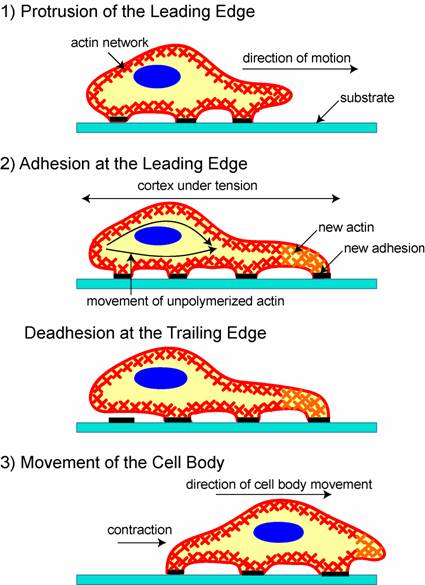
The integrin beta1 is a transmembrane heterodimeric receptor that plays an important role in neuronal migration. This protein has many different functions related with the interaction between the cell and its environment. Yet there are two main ways in which this integrin is involved in neuron growth:
- it is the one responsible for the attachment of the cell to the extracellular matrix,
- and it also permits the cell to be continuously exploring its surrounding to 'decide' which path it has to follow to get the target.
On the other hand, this receptor has a second important function by enabling the neuron to stablish a communication with the environment. The concentration of ligands surrounding the neuron determine the way that the cell should take. So, integrins become, in that sense, the 'nose' of the neuron.


1 comment:
Wow! impressive! When you note that all these kind of things has been done by nature exclusively by means of evolution with no sort of inteligence... It's amazing.
Post a Comment